
In briefThe essentials
What it is
Larvae of nematode worms of the family Anisakidae that live in the marine environment and can be found in fish and cephalopods.
What it causes
Anisakiasis: digestive disorders and allergic reactions, which can be serious.
How to prevent it
Cook fish until it reaches 60 °C for at least one minute throughout the piece or, if it is to be eaten raw or undercooked, freeze it first. See measures.
01Anisakiasis
Anisakiasis is a parasitic zoonosis caused by the accidental ingestion of fish contaminated with larvae of nematode worms of the family Anisakidae. The clinical picture it produces and the associated pathologies are of two types: digestive disorders and allergic reactions.
In both cases, “gastro-allergic anisakiasis”, the consequences can be serious, associated with the accidental ingestion of the parasite and subsequent immunological sensitisation to its antigens, which can be allergenic even when the fish is eaten cooked or frozen (Alonso-Gómez et al., 2004; Caballero and Moneo, 2004).
According to epidemiological data (Audicana et al., 2002), there has been a notable increase in the affected population, especially in countries and regions where a diet based on fishery products is deeply rooted and, above all, where these products are eaten raw or only lightly cooked.
02Anatomy
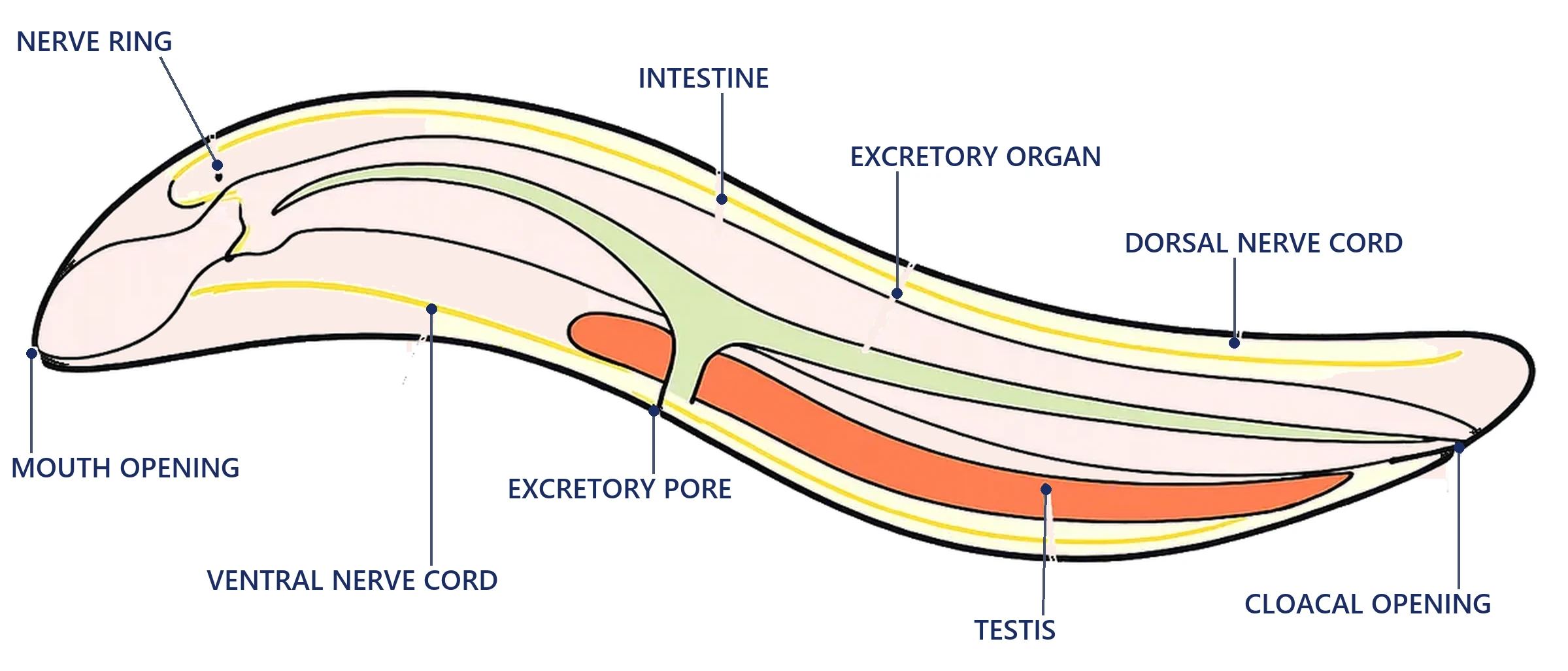
Under the scanning electron microscope, the striated cuticle of the parasite and the structures at its anterior and posterior ends can be seen in detail.
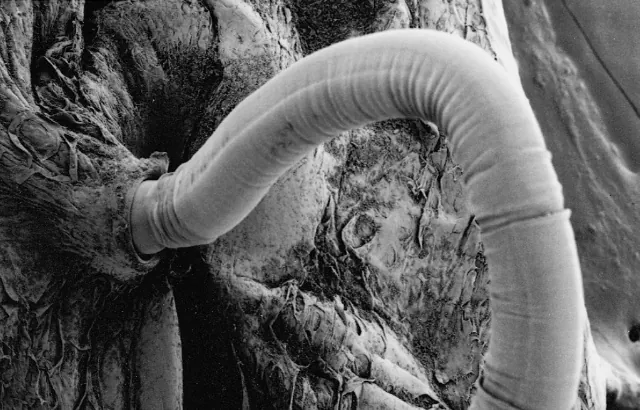
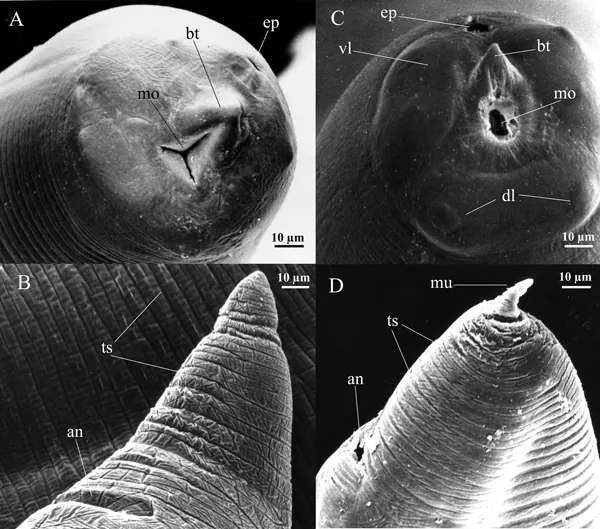
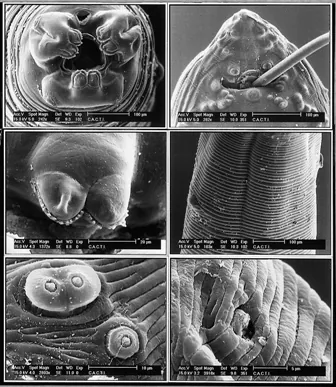
03Life cycle
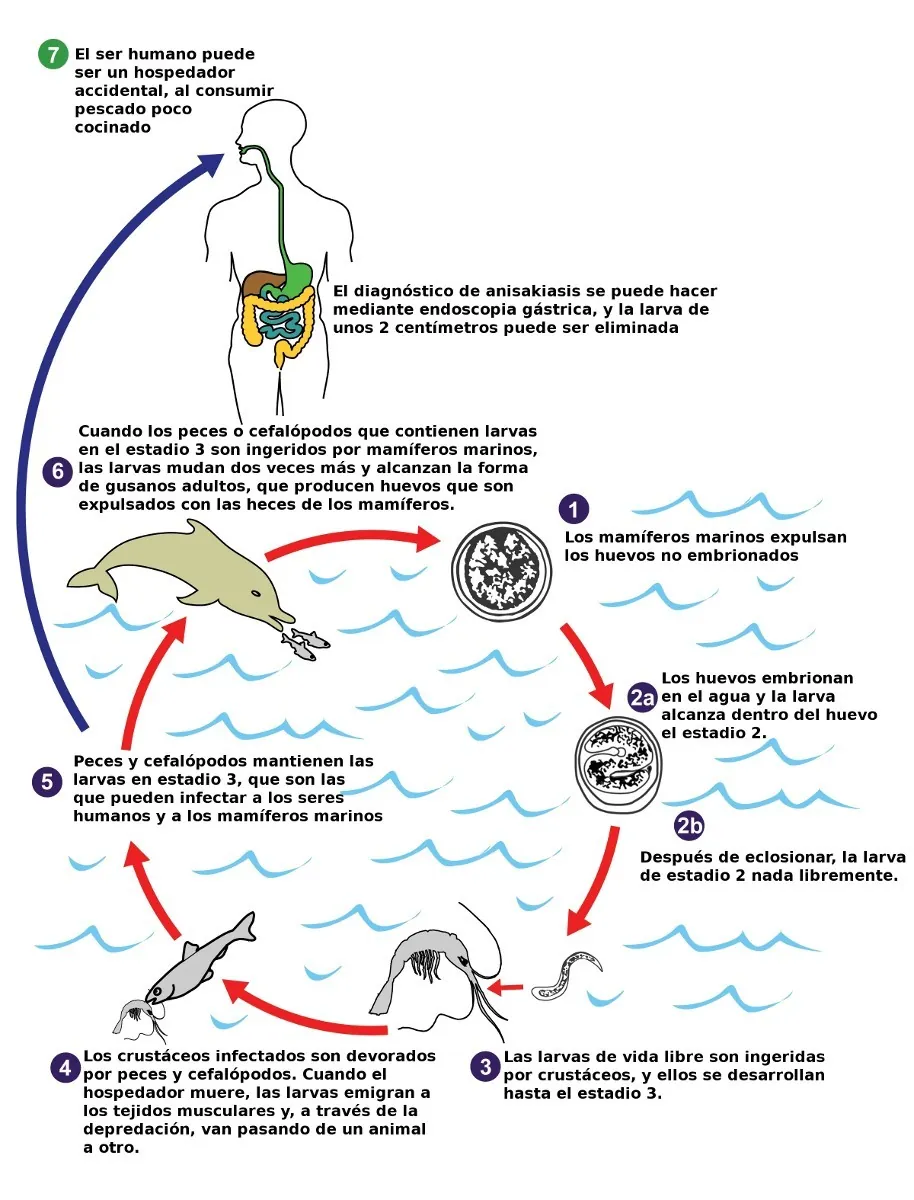
The life cycle of anisakids takes place in the marine environment and requires one or more intermediate and paratenic hosts for the development and dispersal of the larval stages, which reach maturity in many species of marine mammals, their definitive hosts.
The parasite’s success is explained by an evolutionary strategy centred on adapting its life cycle to the trophic ecology of marine ecosystems (Pascual et al., 2007).
Humans are not part of the cycle: they are accidental hosts when they eat fish or cephalopods containing live larvae.
04Prevention and control
Consumer recommendations from the Spanish Agency for Food Safety and Nutrition (AESAN):
- Cook fish until it reaches 60 °C for at least one minute throughout the piece. As a guide, a piece about 2.5 cm thick needs around 10 minutes in total.
- If it is to be eaten raw or insufficiently treated (anchovies in vinegar, pickled fish, sushi, sashimi, carpaccio, ceviche and other marinated fish, cold-smoked fish…), freeze it first at −15 °C or below for at least 4 days; AESAN advises counting 5 days from when it goes into the freezer. If the freezer cannot reach that temperature, buy the fish already frozen.
- Ask for the fish to be gutted when buying it, or do it as soon as possible.
The bottleneck in achieving greater prevention and control of gastro-allergic anisakiasis is prophylaxis against the parasite. Good practice programmes linked to legislative measures have been introduced, clinical diagnostic methods have been improved and expanded, and work is under way in the industry to minimise the presence of the parasite in fishery products, especially in production lines for fish muscle intended for human consumption.
Within this line of work there are two approaches: on the one hand, improving detection and diagnostic systems in the edible part of the fish; on the other, the set of technological measures aimed at inactivating the parasite in fishery products or minimising its presence in exploited stocks. It is here that on-board sanitisation and prevention methods can be important.
The applicable European and Spanish legislation is listed on the Legislation page.
BibliographyReferences
- Anisakis simplex only provokes allergic symptoms when the worm parasitises the gastrointestinal tract.Alonso-Gómez A., Moreno-Ancillo A., López-Serrano M.C., Suárez de Parga J.M., Daschner A., Caballero M.T., Barranco P., Cabañas R. (2004).Parasitology Research: 378-384.
- Anisakis simplex: dangerous — dead and alive?Audicana M.T., Ansotegui I.J., Fernández de Corres L., Kennedy M.W. (2002).Trends in Parasitology, 18 (1): 20-25.
- Several allergens from Anisakis simplex are highly resistant to heat and pepsin treatments.Caballero M.L., Moneo I. (2004).Parasitology Research: 248-251.
- Parasite recruitment and oceanographic regime: a working hypothesis on a global scale.Pascual S., González A., Guerra A. (2007).Biological Reviews, 82: 257-263.
More articles and bibliography under Scientific information.